

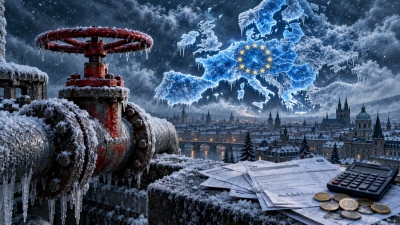
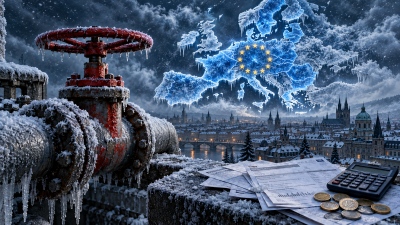
The European Union is facing a severe shortage of natural gas ahead of the winter, which threatens to force the bloc to urgently seek alternative energy sources to cover needs corresponding to the consumption of 12 million households.
This deficit raises the prospect of a winter with skyrocketing electricity bills and the imposition of forced energy-saving measures if the European Union fails to find sufficient supplies elsewhere, according to new reports obtained by Politico.
As the war in Iran continues to disrupt global energy supplies, the European Union faces a total deficit of up to 14 billion cubic meters of natural gas this winter, an amount that represents approximately 7% of the bloc's total demand and is sufficient to power 10 to 12 million European households, according to a report by the American institute Institute for Energy Economics and Financial Analysis.
These findings are also confirmed in a key report by a leading European gas grid operators body, which was presented to national energy officials.
Historic low in reserves and the consequences of high prices
Natural gas is widely used to heat Europe's buildings, power its industry, and generate electricity.
However, European gas reserves have fallen to the lowest level for this time of year since relevant records began in 2011, standing at just over 70%.
This happened because high prices made it more profitable for traders to sell gas earlier during the summer, rather than storing it for later use in the winter.
With natural gas prices near four-year highs and supply restricted due to the US-Israel war in the Middle East, Europe has limited supply options if the upcoming winter proves to be as cold as the previous one, IEEFA finds.
While this does not necessarily mean that the bloc will run out of gas entirely, it means there could be 7 billion fewer cubic meters of stored gas to draw upon.
This could force countries to buy gas at high prices in increasingly volatile global markets or even require consumers to reduce demand if no new supplies are available.

Analysts' warnings about price risks
The record-low reserves of the European Union leave the bloc with a smaller safety cushion against global supply disruptions, making it vulnerable to price spikes, stated Ana Jaller-Makarewicz, lead European energy analyst at IEEFA, in a relevant statement.
She added that if countries are forced to deplete their reserves this year, this will leave them with a greater need for replenishment next year, continuing the vicious cycle of low reserves and higher prices.
The same risks were outlined in the winter supply outlook for the period 2026-2027 published by ENTSO-G, an association of gas operators.
The report warns that if liquefied natural gas imports are limited or even optimal under the conditions of a severe winter, storage levels could fall to as low as 11%, a threshold required for strategic reserves that cannot be easily withdrawn.
If countries hope to restore their reserves to 30% by the end of the winter, otherwise facing increased exposure to future cold spells, volumes equivalent to 7% of demand must either be curtailed or simply withheld from consumers, warns ENTSO-G.
The ban on Russian LNG and increased dependence
Part of this pressure comes from the impending ban on long-term supply contracts for Russian LNG across the European Union, which is scheduled to take effect in January, reducing European gas imports by an additional 7 billion cubic meters, according to the IEEFA report.
Russian gas was historically used to manage winter demand swings, whereas Europe now depends on storage to get through the winter.
To make matters worse, argues the IEEFA report, gas demand during the winter has increased over the past two years, while imports into the bloc have remained stagnant. This has left the European Union relying more heavily on its reserves during the winter period, with net withdrawals amounting to 22.6 billion cubic meters in January 2026, up from 18.8 billion cubic meters in January 2025 and 17.8 billion cubic meters in January 2024.

The enormous cost of American liquefied gas
The alternative solution would be to import new LNG, a seaborne fuel that the European Union is increasingly procuring from the US.
However, at current prices, importing the lost volumes will cost Europeans an additional 3 billion euros, a 12% increase compared to what the same volume would have cost last year, on top of already extremely high prices, according to the report.
LNG production in the US is also near maximum capacity, which means these additional imports will further strain supply, Ana Jaller-Makarewicz told Politico.
For some, a price increase is considered the most likely development.
While ENTSO-G's tight market scenario assumes a global deficit that sees available LNG imports to Europe fall by 20%, Laurent Ruseckas, senior gas market analyst at S&P Global Energy, argues that storage can only fall to a certain point, as rapid withdrawals early in the winter will push prices up, attracting cargoes to Europe from Asia.
There is not much demand left to destroy in Europe, he added, pointing out that the war in Ukraine has already destroyed 20% of the bloc's industrial demand, which never returned.
How did we get here? How Brussels' decisions led to today's impasse
A pivotal point for the dramatic change of perspective in the European Union, which had turned entirely in recent years toward the development of renewable energy sources to break free from hydrocarbons in order to address the climate crisis, according to political declarations, was the war in Ukraine.
The journey of the European Union from the outbreak of the war in Ukraine in 2022 until today constitutes one of the most controversial chapters of modern European history.
The effort by the leadership in Brussels, spearheaded by Ursula von der Leyen, Emmanuel Macron, the new High Representative for Foreign Affairs and Security Policy of the Union Kaja Kallas, and Friedrich Merz in Germany, to completely cut off the old continent from Russia, was accompanied by decisions that radically restructured capital flows and the energy security of Europe, worsening shortages and bills for European households.
The first wave of sanctions and the energy shock (2022-2023)
With the invasion of Ukraine, the EU imposed successive sanctions packages aimed at excluding the Russian banking system (disconnection from SWIFT) and freezing approximately 300 billion dollars of the foreign exchange reserves of the Central Bank of Russia.
In the energy sector, the halt of flows through the Nord Stream pipeline and the REPowerEU plan aimed at an immediate termination of dependence on cheap Russian pipeline gas.
However, the transition did not happen smoothly, but through two moves:
a. Turn to expensive LNG
Europe turned en masse to imports of liquefied natural gas (LNG), primarily from the US.
This sent transport and storage costs soaring, while forcing member states to pay hundreds of billions of euros in subsidies to keep citizens' bills down.
b. Bypassing sanctions
Despite declarations of complete exclusion, the EU continued to import Russian LNG in record quantities, paying billions of euros to Moscow, while Russian oil was channeled into the European market via third countries (such as India and Turkey) at significantly higher prices due to middlemen.

The channeling of European capital into the abyss of... Kyiv
Alongside energy costs, enormous sums from European budgets and lending mechanisms were channeled to support Kyiv.
Through the European Peace Facility (EPF) and the Ukraine Facility, tens of billions of euros were transferred to cover Ukrainian public sector salaries, finance armaments, and produce war materiel.
The decision to use the proceeds from immobilized Russian assets to provide loans to Ukraine provoked strong reactions in international markets, raising concerns about the credibility of the euro as a reserve currency.
Deindustrialization and today's impasse
The strategic choice for rapid severance from cheap Russian raw materials, without the existence of sufficient and cheap alternatives, triggered a domino effect across the European economy.
Europe's industrial core lost its competitiveness.
Giant companies in Germany and France either cut production or relocated operations to the US and Asia, where energy costs are a fraction of those in Europe.
Replacing Russian energy dependence with a new, more expensive dependence on American LNG supplies and American defense contractors drastically limited the strategic autonomy of the EU.
The policy pursued by leaders in Brussels led to a double impasse: on one hand, Russia redirected its exports to Asian markets, while on the other, European citizens and European industry are today called to pay the bill for a prolonged energy and fiscal crisis.
www.bankingnews.gr


Σχόλια αναγνωστών